Curriculum
Course: Geometry
Login
Text lesson

1.1 Introduction to Geometry

📐 Introduction to Geometry

Where numbers meet shapes, and space becomes measurable.

Geometry, a branch of mathematics, explores the properties of space, dealing with concepts like distance, shape, size, and the relative positions of figures. The word “geometry” comes from the Ancient Greek term γεωμετρία (geōmetría), meaning ‘land measurement’. It’s derived from γῆ (gê) meaning ‘earth, land’ and μέτρον (métron) meaning ‘a measure’.

Alongside arithmetic, geometry stands as one of the most ancient branches of mathematics. Mathematicians who delve into the world of geometry are known as geometers.

For centuries, geometry focused on Euclidean principles: points, lines, planes, distances, angles, surfaces, and curves. But in the 1800s, mathematicians introduced non-Euclidean geometries, breaking the rules about parallel lines — a discovery that shaped Einstein’s theory of general relativity.

Today, geometry influences art, architecture, science, design, engineering, and even abstract fields like algebraic geometry, which helped solve Fermat’s Last Theorem!
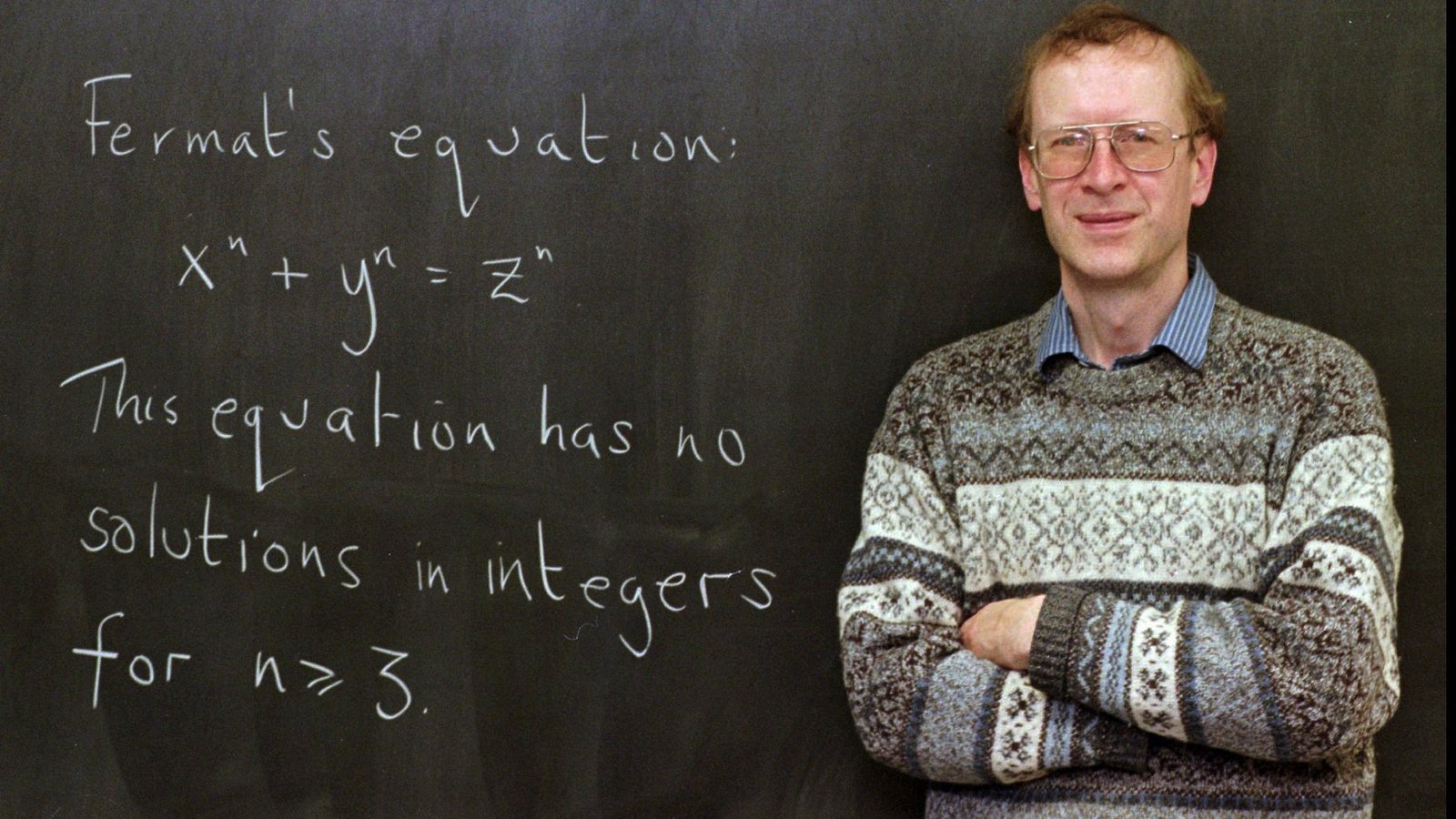
Andrew Wiles with Fermat's Last Theorem

Mathematics professor Andrew Wiles has won a prize for solving Fermat’s Last Theorem. He’s seen here with the problem written on a chalkboard in his Princeton, N.J., office, back in 1998.
🌟 Fun Fact

  • Ancient Egyptians used geometry to divide land after the Nile flooded every year.
  • “Geo” means earth, and “metry” means measure — geometry began as a way to measure land!
  • Even nature uses geometry — think honeycomb hexagons or spiral galaxies.

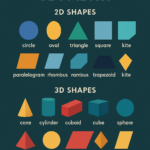
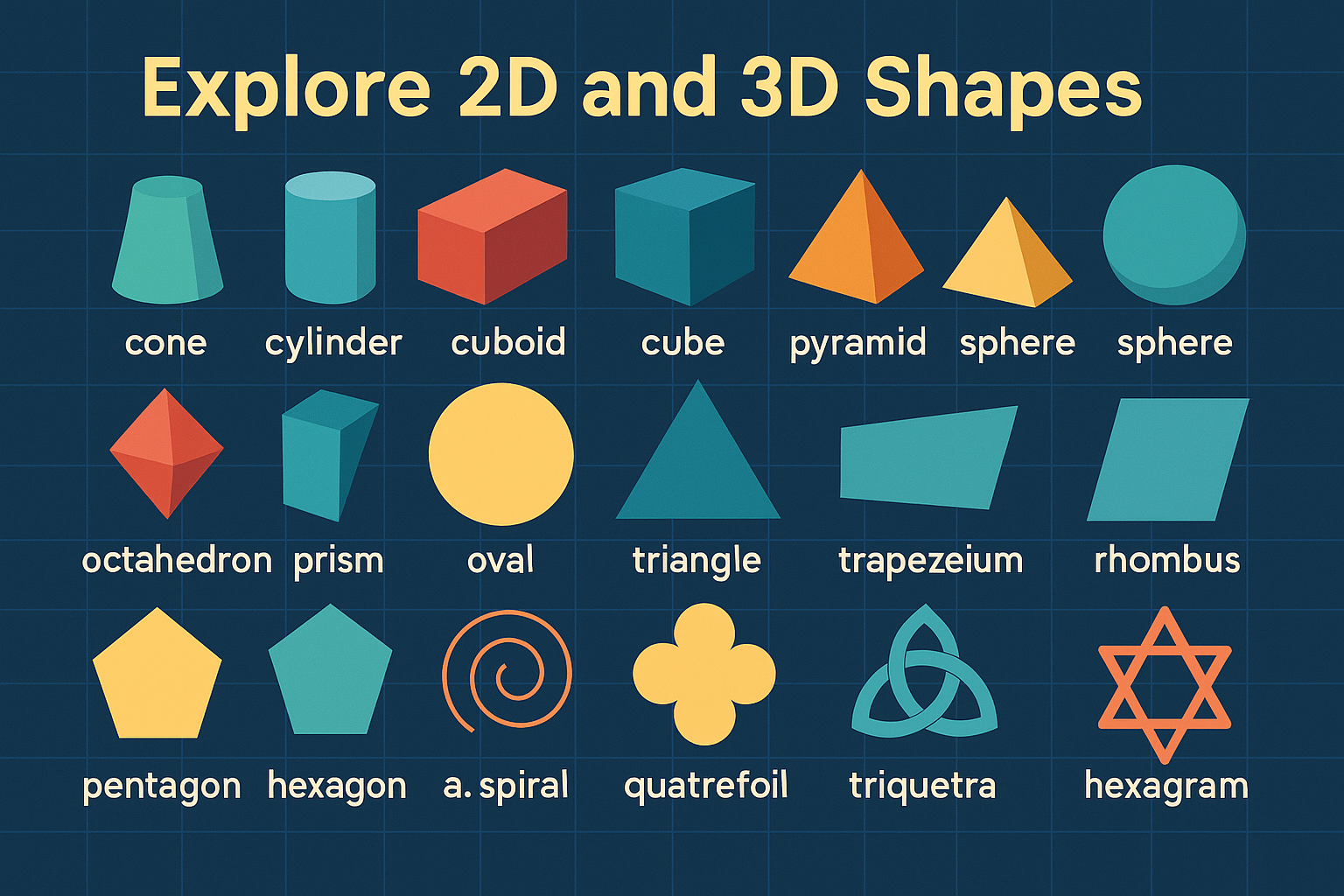
🔺 Explore 2D and 3D Geometric Shapes

Explore 2D and 3D Shapes

🔤 Basic Terms in Geometry

  • Point: A location in space with no size or shape.
  • Line: A path extending in both directions infinitely.
  • Plane: A flat surface extending without end.
  • Segment: A line with two endpoints.
  • Ray: A line with one endpoint that extends infinitely in one direction.
  • Angle: Formed by two rays sharing a common endpoint.

📏 Classifying Angles

  • Acute: Less than 90°
  • Right: Exactly 90°
  • Obtuse: Greater than 90° but less than 180°
  • Straight: Exactly 180°

🔗 Angle Relationships

  • Complementary Angles: Sum to 90°
  • Supplementary Angles: Sum to 180°
  • Vertical Angles: Opposite angles formed by intersecting lines (equal in measure)

Try this: If an angle’s supplement is 130°, what’s its measure? 50°

📌 Summary

  • Geometry helps us describe and measure space, shapes, and size.
  • It’s used in art, science, engineering, architecture, and even outer space!
  • You’ll encounter both flat (2D) and solid (3D) geometry in real life.